Diffuse intrinsic pontine glioma, DIPG, is a rare and aggressive pediatric brain cancer with a median survival of less than two years post-diagnosis. Its location within the pons makes surgical removal impossible, and the blood-brain barrier blocks large-format biologics, including antibodies and chimeric antigen receptor T-cells, that have shown promise in other ROR1/2-positive malignancies. Receptor tyrosine kinase-like orphan receptors 1 and 2, ROR1 and ROR2, are well-validated oncological targets in leukemia and several solid tumors, but their role in DIPG had not been established, nor had any pharmacological tool been designed to probe it.
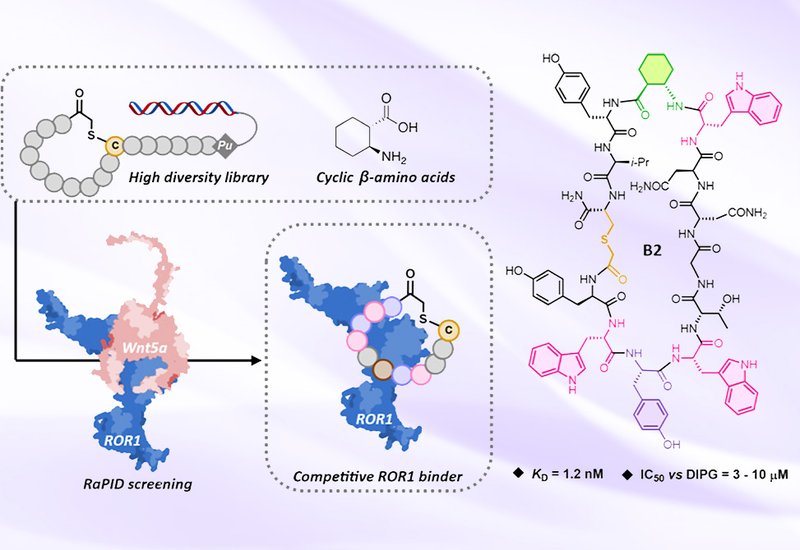
Researchers in the Suga Lab at The University of Tokyo and the Swartling Group at Uppsala University, published in ACS Chemical Biology, undertook de novo discovery of macrocyclic peptide inhibitors of ROR1/2 using the RaPID, random nonstandard peptides integrated discovery, platform. Two large libraries exceeding 1012 members were designed with the flexible in vitro translation system: library K encoded all 20 proteinogenic amino acids initiated by chloroacetyl-D-tyrosine for thioether macrocyclization, while library BR and a focused derivative, library BF, incorporated three cyclic β-amino acids, cβAAs, by reprogramming select codons via flexizyme technology. Seven rounds of affinity selection against immobilized ROR1 were followed by next-generation sequencing to identify enriched sequences for chemical synthesis and characterization.
Both libraries converged on a highly conserved peptide family centered on a cluster of aromatic residues, particularly a WXW motif at the N-terminus. Surface plasmon resonance analysis showed that all synthesized macrocycles bound ROR1 with dissociation constants in the single-digit nanomolar range, compared to a KD of 32.8 nM measured for the endogenous ligand Wnt5a under identical conditions. Despite this near-uniform binding affinity across the series, cellular screening against four SU-DIPG cell lines revealed a sharp divergence: only peptide B2, a cβAA-containing macrocycle from library BF, suppressed viability across all tested lines at 10 μM, with IC50 values ranging from 3 to 10 μM. No other family member showed measurable cellular activity at this concentration, and B2 had no detectable effect on MCF7, an ROR1-negative control line, confirming selectivity for ROR1/2-positive cells.
Mechanistic investigation revealed why B2 stands apart. A RaPID competitive clone assay showed that K1, K2, and K3 achieved competition-to-positive recovery ratios below 0.1 when ROR1 was pre-saturated with Wnt5a, while B2 gave a ratio of 1.18, demonstrating its capacity to displace the endogenous ligand. Tryptophan fluorescence quenching assays corroborated this: ROR1 quenched the fluorescence of B2 upon binding, even when Wnt5a was pre-bound, whereas the fluorescence of K1 was not quenched. A β3-to-alanine mutant of B2 retained ROR1 binding but lost competitive function, identifying the cβAA at position 10 as the structural determinant of Wnt5a displacement. The authors attribute B2's unique activity to a putative β-hairpin conformation induced by this residue, positioning the WYW motif for productive receptor engagement and accelerating association kinetics relative to the rest of the series. B2 also bound the Frizzled-7 cysteine-rich domain by SPR, with roughly 20-fold reduced affinity, and reduced viability in the medulloblastoma line MB002 EV, broadening the potential scope of the target class.
Serum stability studies found B2 degraded at the Y3/W4 motif with a t1/2 of 1.75 h. Five mutants incorporating D-amino acid or N-methylated substitutions at these positions extended half-lives to 10 to 48 h, though this came at a cost to cellular activity: stabilized variants retained potency only in cell lines with high ROR1 or Wnt5a expression, indicating that the Y3/W4 motif is critical for functional engagement. These findings establish ROR1/2 as a viable therapeutic target in DIPG and identify macrocyclic peptides as a tractable modality for its inhibition, with B2 serving as a chemical probe for dissecting Wnt pathway biology in these tumors. Future work will require improving serum stability without sacrificing competitive function, as well as addressing blood-brain barrier penetration to advance this scaffold toward preclinical development.